Mercury Has Poisoned Ghana's Water, Soil, and People
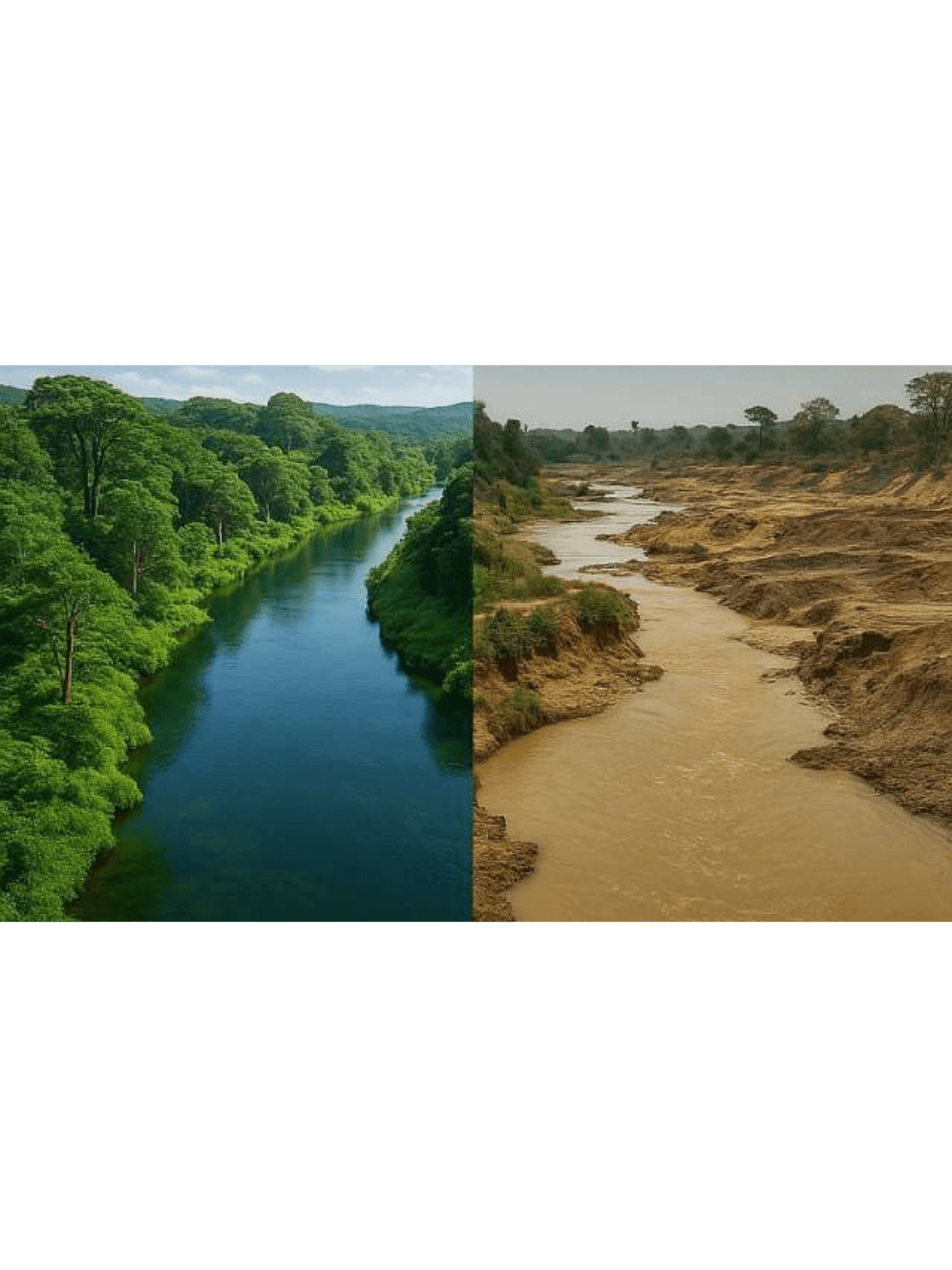
Over 6 million Ghanaians live with contaminated water and poisoned land. Rivers once full of life now run orange with mercury and toxic sediment. Farmland that fed generations now grows poisoned crops. Children miss school to fetch water that still makes them sick. Communities watch their land collapse under illegal mining waste.

We're here to reverse it — restoring Ghana's soil and water together, because one cannot heal without the other.
WARNING
Ghana's Rivers Are Dying — and 6 Million People Are Dying With Them
Galamsey — Ghanaian pidgin for "gather and sell" — was once small-scale traditional mining practiced sustainably for generations. That changed when foreign operators introduced heavy machinery, mercury amalgamation, and cyanide processing across Ghana's mining regions.
The destruction is total. Over 60% of Ghana's water bodies are contaminated or destroyed (Ghana Water Resources Commission). Rivers like the Pra, Ankobra, Offin, and Birim—waterways that sustained communities for generations—are biologically collapsing (NBC News, Oct 2024). The soil beneath them is saturated with mercury, lead, arsenic, and cadmium.
Mercury contamination in some areas reaches 130-150 times above safe limits. Arsenic levels exceed WHO standards by over 4,000% in the hardest-hit communities. Ghana EPA/Pure Earth Study, 2025). What poisons the water poisons the land.
The contamination doesn't stay contained. Mercury moves from rivers into soil, from soil into groundwater, from groundwater into food crops, and from food crops into the bodies of the people who eat them. Over 6 million Ghanaians now live with contaminated water and poisoned land (Wilson Center). Ghana's state water utility has warned the country may face a water import crisis by 2030 if current trends continue.
The health toll is devastating. Mercury crosses the blood-brain barrier and the placental barrier—poisoning developing brains and unborn babies. Children in galamsey-affected regions across Ghana are showingare showing cognitive deficits, delayed speech development, and IQ loss (Ghana Paediatric Society). Doctors are reporting children requiring dialysis due to mercury poisoning, with mercury pellets visible on X-rays (Ghana Parliament, Oct 2025). Birth defects—including neural tube damage and limb deformities are rising in mining communities (CNN Investigation). An entire generation is being contaminated before they take their first breath.
This crisis does not stop at Ghana's borders. Contaminated rivers flow into the Atlantic Ocean, carrying mercury and heavy metals into the global marine food chain. Mercury levels in fish from Ghana's coastal waters exceed WHO limits — fish that enter international markets and onto tables worldwide.
If this work doesn't start now, we're not just abandoning Ghana. We're guaranteeing a future where this contamination reaches everywhere, into everything, irreversibly. The rivers flow to the ocean. The ocean feeds the world. The world includes you.
We have the plan. We have the team. We don't have time — and we can't do this alone.
Track Illegal Mining Activity Across Ghana in Real Time
Watch the spread of illegal artisanal mining across Ghana's mining regions. This interactive map surfaces contamination hotspots, destroyed waterways, and communities most at risk. Stay informed. Stay aware. Help amplify the call for action.
HOW GHANA'S MINING CRISIS REACHED THIS POINT — AND WHY IT'S SO HARD TO REVERSE
For generations, Ghanaians mined gold sustainably. Traditional communities built real wealth while forests stayed intact and rivers ran clean. What you see today is not Ghanaian tradition. The destruction, the poison, and the dying waterways were brought in by foreign operators in the early 2000s and left behind for Ghanaians to survive.
WHY GALAMSEY CONTINUES -- AND WHY ENFORCEMENT ALONE FAILS
To understand why illegal mining keeps spreading across Ghana, you have to understand what poverty actually looks like on the ground. In the hardest hit regions, unemployment runs above 40%. An artisanal miner takes home $20 to $30 a day. That is three times what a formal job pays -- if a formal job exists at all.
For a parent watching their children go hungry, that is not a moral question. That is math.
Government crackdowns have failed over and over. Military raids, arrests, equipment seized and burned -- none of it sticks. Shut one site down and three more open deeper in the forest. Hundreds of tonnes of mercury pour into Ghana's environment every year and it keeps happening because the people doing it have nowhere else to turn.
You cannot arrest poverty. You cannot enforce your way out of survival.
WHY CONVENTIONAL REMEDIATION CANNOT SOLVE THIS
Conventional remediation was built for wealthy countries. It needs billion dollar budgets, foreign contractors, imported technology, and timelines that stretch 30 to 50 years. It treats communities as problems to manage instead of people to work with.
The standard price tag is $15 to $20 billion. The standard timeline is decades.
The track record for developing countries: conventional techniques are "no longer sustainable and are ineffective in rehabilitating abandoned mining sites, especially in developing countries."
INFN8 VZN is not waiting for a $15 billion solution. We are building something lean, agile, and designed for real impact in communities that cannot afford to wait. Every resource is tracked. Every outcome is measured.
And this model is not theoretical. It has been proven:
In Canada, the Bralorne-Takla mercury mine was fully remediated by 2017—hazardous waste removed, site revegetated, ecosystem restored.
The Colomac Mine remediation entered into engineering awards and delivered 75% of employment to Indigenous communities.
In Australia, the Orica Botany project recovered 1,200 kg of mercury from contaminated soil between 2013-2017. Kalgoorlie's gold operations cut mercury emissions by 97% in a single decade.
In California, the Gambonini Mercury Mine demonstrated that consolidating waste and deploying hydrologic controls works.
Globally, UNEP's planetGOLD programme has prevented over 31 tonnes of mercury emissions and supported 17,200+ miners transitioning to mercury-free methods across Burkina Faso, Indonesia, the Philippines, and Kenya.
The technology is real. The methods work. What is missing is deployment in Ghana. That is exactly what we are here to do.
The Clock Is Ticking -- Ghana Cannot Wait
Every day this goes on, more mercury works its way deeper into Ghana's soil. More children drink poisoned water. More farmland dies. The damage does not pause while the world talks about solutions.
The technology is there. The model works. What is missing is the will to deploy it -- and the resources to start.
Your donation does not fund another study or another decade of planning. It puts real remediation equipment to work in Ghana. It trains local operators who stay long after we leave. It gets the first sites running and proves this can work at scale.